


JINYUAN
JINYUAN
JINYUAN
JINYUAN
JINYUAN
JINYUAN
JINYUAN
JINYUAN
JINYUAN
JINYUAN
JINYUAN
JINYUAN
JINYUAN
JINYUAN
JINYUAN
JINYUAN
Content
A municipal road project needed lighting for a 12 km section with no grid access. The cheapest solar bid was less than one fifth of the most expensive one, yet both claimed to be "advanced." The real difference was in how the photovoltaic panel, battery, controller, optics, and pole were sized and verified as one system. Advanced solar lighting systems deliver that reliability—but only when every link in the chain is designed for the same climate, duty cycle, and maintenance plan.
What Makes a Solar Lighting System "Advanced"?
A solar lighting system is advanced when it can guarantee a defined illuminance level through the night, year after year, without draining the battery on bad-weather days. Advanced does not mean the most powerful LED or the largest panel. It means the whole configuration—generation, storage, control, optics, and structure—works within measured tolerances.
Engineering for Reliability, Not Just Peak Power
The first thing to check is how the system behaves on consecutive cloudy days. A single-day autonomy number can hide a system that fails in winter. Advanced systems use maximum power point tracking (MPPT) controllers, lithium iron phosphate (LiFePO4) batteries, and multi-stage charging to extend battery life beyond the typical three to five years.
Smart Control and Data Access
The second distinguishing feature is control. A basic system simply switches on at dusk and off at dawn. An advanced system dims late-night hours, brightens on motion detection, and logs performance data. Remote monitoring allows a maintenance team to see battery voltage and fault status from an office instead of driving to every pole.
Environmental Resilience
The third feature is how the hardware survives weather. Look for ingress protection (IP) ratings on both the luminaire and the battery enclosure, corrosion-resistant pole coatings, and wind-load calculations that match the installation site. Split-type designs reduce wind load on the pole; all-in-one designs reduce wiring but place the whole package at the top.
Core Components and Configuration Choices
All advanced solar lighting systems share the same basic architecture, but the quality of individual components determines both the initial cost and the total cost of ownership. The battery and charge controller matter as much as the LED, and often fail earlier.
| Component | Function | What to Verify |
|---|---|---|
| Photovoltaic panel | Converts sunlight into charging current | Cell type (mono-crystalline preferred), module efficiency, mechanical strength to resist wind and hail |
| Battery | Stores energy for night operation and cloudy days | Chemistry (LiFePO4 recommended), cycle life, operating temperature range, enclosure protection |
| Charge controller | Manages charging and discharging | MPPT vs. PWM, low-temperature protection, communication interface |
| LED luminaire | Delivers useful light with controlled distribution | Luminous efficacy, beam pattern, thermal design, IP rating |
| Pole and mounting | Supports hardware and resists environment | Wind-load class, coating thickness, tiltable design for maintenance |
Project teams rarely compare every row in detail, which is why a low-priced bid often uses the smallest battery and the thinnest pole that still matches a photo in the datasheet. Before comparing specific fixtures, it helps to review the complete solar lighting product family available from a single supplier, because the architecture decision is independent of the LED brand.
All-in-One or Split-Type: Choosing the Right Architecture
Configuration is a maintenance and installation decision, not a marketing label. All-in-one systems integrate the panel, battery, and luminaire in a single package; split-type systems mount them separately. The correct choice depends on pole height, site access, wind conditions, and who will service the equipment.
All-in-One Solar Street Lights
All-in-one units are attractive for quick installation because factory wiring means fewer connection faults on site. They suit road renovation and village projects where cranes are available and poles are not too tall. Our high-efficiency adaptive all-in-one solar street light, for example, includes tiltable panel adjustment and dimming profiles for typical rural roads. The trade-off is that the battery operates in a hotter, more exposed enclosure, and replacing it often requires lowering the entire unit.
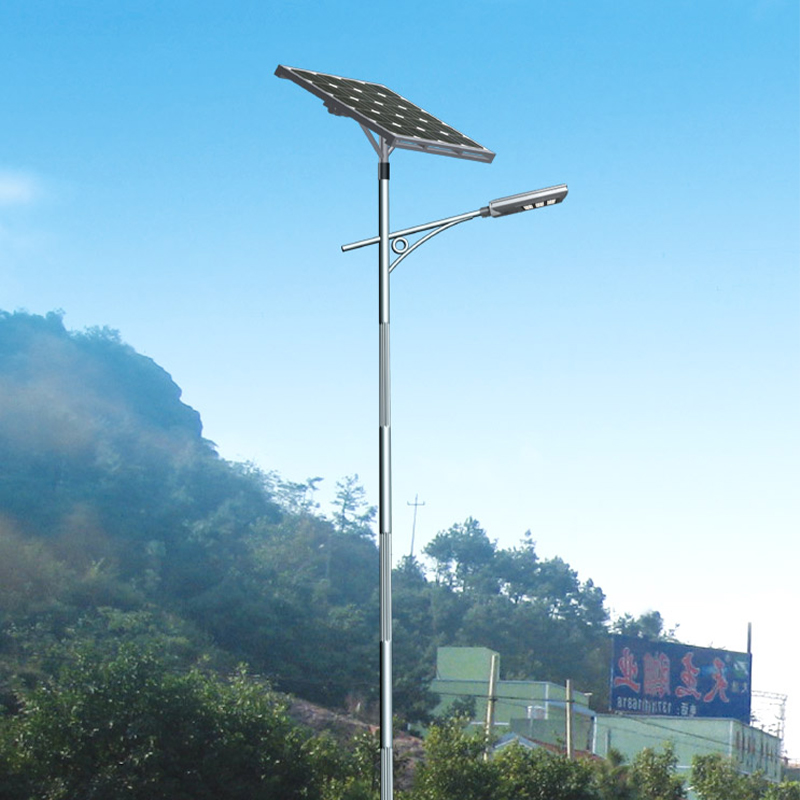 Wholesale High-Efficiency Adaptive All-in-One Solar Street Lights Suppliers, FacYangzhou Jinyuan Lamps Co.,Ltd. is China wholesale High-Efficiency Adaptive All-in-One Solar Street Lights suppliers and High-Efficiency ...View Product →
Split-Type Solar Street Lights
Split-type systems keep the photovoltaic panel on top and the battery near the ground or inside the pole. This arrangement reduces heat stress on the battery, makes service simpler, and allows a larger panel footprint for higher latitudes or long rainy seasons. The wind-resistant and waterproof split-type solar street light is sized for coastal roads and open highways where wind load and salt corrosion are the main threats. The trade-off is more cabling and a longer installation time.
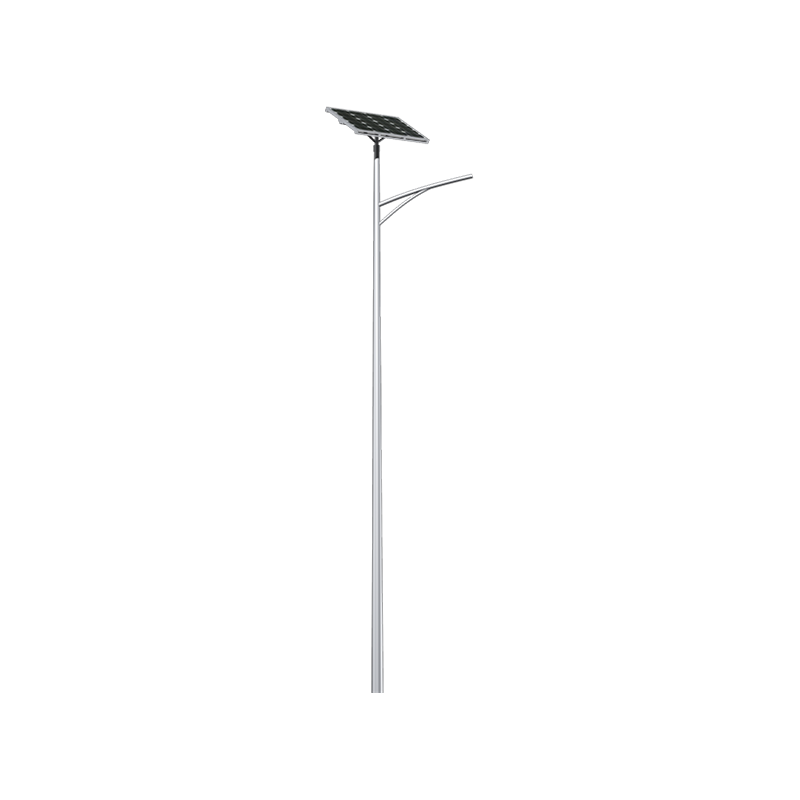 Wholesale Wind-Resistant And Waterproof Split-Type Solar Street Light Suppliers,Yangzhou Jinyuan Lamps Co.,Ltd. is China wholesale Wind-Resistant And Waterproof Split-Type Solar Street Light suppliers and Wind-Resista...View Product →
How the Configurations Compare
| Criterion | All-in-One | Split-Type |
|---|---|---|
| Installation speed | Fast, factory pre-wired | Slower, on-site wiring |
| Battery environment | Higher temperature, protected frame | Cooler ground-level enclosure, easier service |
| Wind load on pole | Higher package on top | Lower, panel independent |
| Maintenance | Replace unit or lower the entire package | Replace battery or controller separately |
| Typical use cases | Village roads, parks, renovation work | Highways, coastal areas, harsh climates |
For a more detailed look at the maintenance consequences, our comparison of all-in-one versus split-type solar street lights walks through service records from real field installations.
Intelligent Controls and Hybrid Grid Connectivity
The defining feature of an advanced system is its ability to adapt brightness and report status without a site visit. This capability separates a lighting product from a complete lighting solution.
Adaptive Dimming and Remote Monitoring
A typical advanced profile runs at 100 percent during peak hours, dims to 40 percent after midnight, and returns to full output during early-morning commuting. Motion sensors can raise the level when a vehicle passes. These profiles reduce battery discharge by 25 to 40 percent and stretch battery life in proportion. Remote monitoring adds a communication link—NB-IoT, LoRa, or 4G—that sends voltage, temperature, and fault codes to a central dashboard.
Solar-Plus-Grid Hybrid Operation
In urban sections where grid connection is available, hybrid operation is becoming a standard option. The lighting system charges from solar during the day and switches to grid power only when battery storage is exhausted. In this mode, projects can cut energy use by up to 80 percent compared with conventional street lighting while keeping the safety margin of a grid connection. Our integrated solar smart street light supports this hybrid mode, and the controller can be configured for demand-based tariffs.
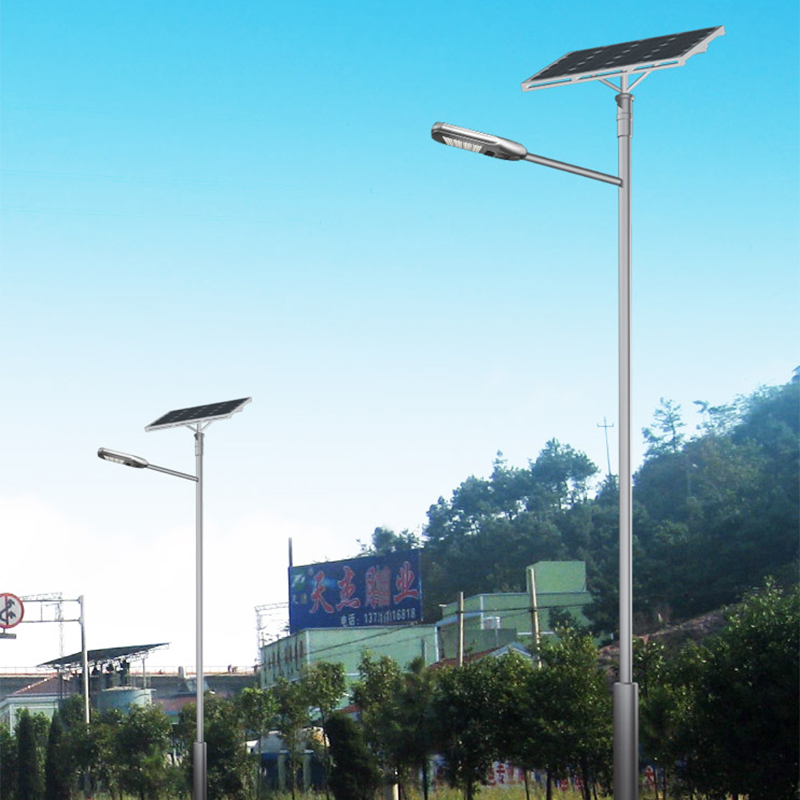 Wholesale Integrated Solar Smart Streetlight Suppliers, Factory - Yangzhou JinyuYangzhou Jinyuan Lamps Co.,Ltd. is China wholesale Integrated Solar Smart Streetlight suppliers and Integrated Solar Smart Streetlight fa...View Product →
Smart lighting upgrades are often the first step for cities preparing traffic and environmental sensor networks, because the lighting pole already carries power, communication, and a management platform. We cover the wider planning context in our overview of smart street lighting solutions.
What to Verify Before You Purchase
Specifications matter only when they are backed by testing, certification, and a supplier that can show you a production line. In field failures, the components that cause the most downtime are not LEDs—they are batteries, controllers, and connections that were never matched to the local climate.
Certifications and Manufacturing Traceability
Ask for ISO 9001 quality management, ISO 14001 environmental management, and ISO 45001 (or the earlier OHSAS 18001) occupational health and safety certification. These certificates do not guarantee a perfect product, but they indicate that the factory controls welding, coating, battery assembly, and testing processes. If possible, visit the factory or request a recorded tour of the production and load-testing areas before placing a large order.
Performance Data and Warranties
Work through the performance variables deliberately:
- What is the guaranteed autonomy at -10°C?
- How many charge-discharge cycles reach 80 percent capacity?
- What is the wind-load rating of the pole with the solar panel mounted?
- Who supplies the battery, and what is the replacement lead time?
- Does the warranty cover the battery, the luminaire, and the controller separately?
Compare those answers with the contract terms. A five-year warranty on the LED lens is common, but the battery and controller typically fail first. The same logic applies to the photometric report: luminous flux measured in a laboratory is not the same as delivered light on a pole in summer.
Where Advanced Solar Lighting Delivers the Most Value
The strongest business case is in projects where power availability and maintenance cost are both critical, not in the cheapest roadside lantern. Typical scenarios include:
- Highways and rural roads where grid extension costs more than the lights themselves;
- Coastal roads and ports that need salt-resistant hardware and low wind load;
- Industrial parks and campus projects with a sustainability policy and a central management team;
- Sports fields and remote logistics yards that need reliable lighting without diesel noise.
For larger sites, solar lighting combines well with high-mast or high-pole structures to reduce the number of ground poles, and the photovoltaic system can be sized together with the lighting load to create a single energy contract.
Advanced solar lighting systems are not a single product—they are an engineering package. The most reliable way to evaluate them is to compare components, review certification, and ask how the system behaves on cloudy days and in hot summers. A supplier that can answer those questions with tested data and production evidence is more valuable than one that simply offers the best per-watt price.